What Should You Look for in a VPN? A Beginner’s Guide
Choosing a VPN can feel confusing if you are new to online privacy tools. Many VPN providers talk …


Every year there’s a new headline that makes you wonder if it’s finally time to get a VPN: another data breach, a trip abroad, a warning about the Wi-Fi at your favorite coffee shop. Here’s the short version: if you’re online in 2026, and let’s be honest, who isn’t, a VPN isn’t the nice-to-have it used to be. Between phones, smart TVs, and shared networks, most of us leak more information than we realize, every single day.
Here’s a clear-eyed look at what a VPN actually does, who benefits most, and why it’s become less of a luxury and more of a basic online habit, like locking your front door.
Quick answer: yes, you probably need a VPN. If you use public Wi-Fi, work remotely, travel, stream, or just don’t love the idea of your internet provider logging everything you do online, a VPN closes that gap. Even on a trusted home network, it’s doing quiet work in the background you’d otherwise be doing without.
Here’s the simple version: a VPN encrypts your traffic and routes it through a secure server, so your real IP address stays hidden and anyone else on your network, including your internet provider, has a much harder time seeing what you’re up to online. It’s not a magic invisibility cloak, sure, but it closes a privacy gap that’s wide open right now, on your phone, your laptop, and every public network you’ve joined without thinking twice.
That gap matters more than people think: according to Security.org’s 2025 VPN Trends report, a nationally representative survey of over 1,000 U.S. adults, about 75 million Americans currently use a VPN to improve their online privacy and security. That said, adoption has been volatile rather than steadily rising. U.S. VPN usage climbed from 39% of adults in 2022 to 46% in 2023, then fell back to 32% in 2025, suggesting many people still treat VPNs as optional rather than essential.
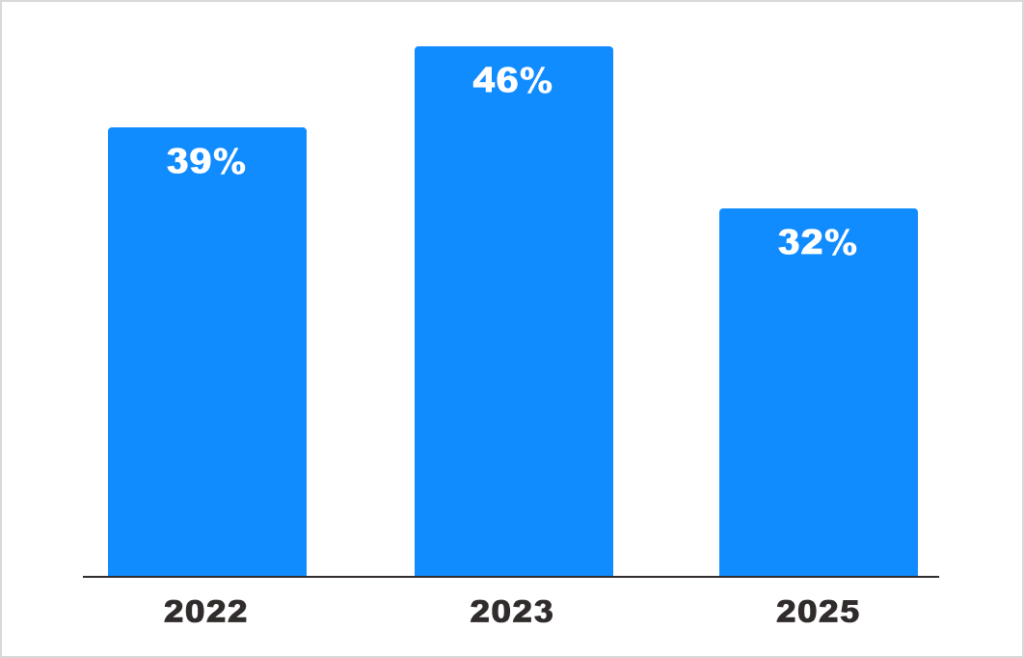
This recent dip doesn’t necessarily tell the whole story going forward. Security researchers have been tracking a sharp rise in AI-generated phishing emails, deepfake voice and video scams, and other automated attacks aimed at everyday users. As those threats become harder to spot, some analysts expect VPN adoption to climb back up in 2026 as more people look for straightforward ways to reduce their exposure. The FBI’s 2025 Internet Crime Report backs this up: it broke out AI-related fraud as its own complaint category for the first time this year, logging over 22,000 complaints and nearly $893 million in reported losses.
Technically, not everyone needs a VPN running 24/7. Realistically, most of us tick at least one of these boxes without even thinking about it:
Before you decide, it’s worth clearing up a few myths that talk people out of a VPN for the wrong reasons.
If you’re leaning toward getting a VPN, prioritize a provider with:
Hotspot Shield, for example, is built around these fundamentals: AES-256 encryption, a kill switch, IP and DNS leak protection, and a proprietary Hydra protocol designed to keep speeds fast even with encryption turned on.
A VPN is likely worth it if you:
Honestly, most people check at least one of those boxes without realizing it. And even if you don’t right now, a VPN is cheap insurance for the day your habits change, or your Wi-Fi does.
A VPN isn’t about paranoia; it’s about closing a privacy gap that’s open every single time you connect to the internet, especially on networks you don’t control. Realistically, in 2026 there’s very little reason not to run one. A lightweight, easy-to-use VPN like Hotspot Shield gives you real protection without adding friction to daily browsing, streaming, or working online, so the only real question left is why you’d wait.
Do I really need a VPN if I don’t do anything sensitive online?
Yes. Even routine browsing sends data across networks that others may be able to see, especially on public Wi-Fi. “Nothing to hide” isn’t the same as “nothing worth protecting,” and a VPN covers you regardless of how sensitive your activity feels.
Will a VPN slow down my internet speed?
It can cause a small dip in speed since traffic is routed through a secure server, but modern protocols like Hotspot Shield’s Hydra protocol are designed to minimize that effect.
Is a free VPN good enough for everyday use?
Free VPNs can offer basic protection, but often come with data limits, fewer servers, or weaker privacy policies. A paid plan with strong encryption and no-logs practices tends to offer more reliable protection.
Can a VPN replace antivirus software?
No. A VPN protects your connection and privacy, while antivirus software protects your device from malware. Many users benefit from having both.


Choosing a VPN can feel confusing if you are new to online privacy tools. Many VPN providers talk …

If you travel frequently, you may have noticed that streaming platforms sometimes behave differently when you’re outside your …

The easiest way to improve your digital privacy is to switch your IP address using a VPN. We’ll …